
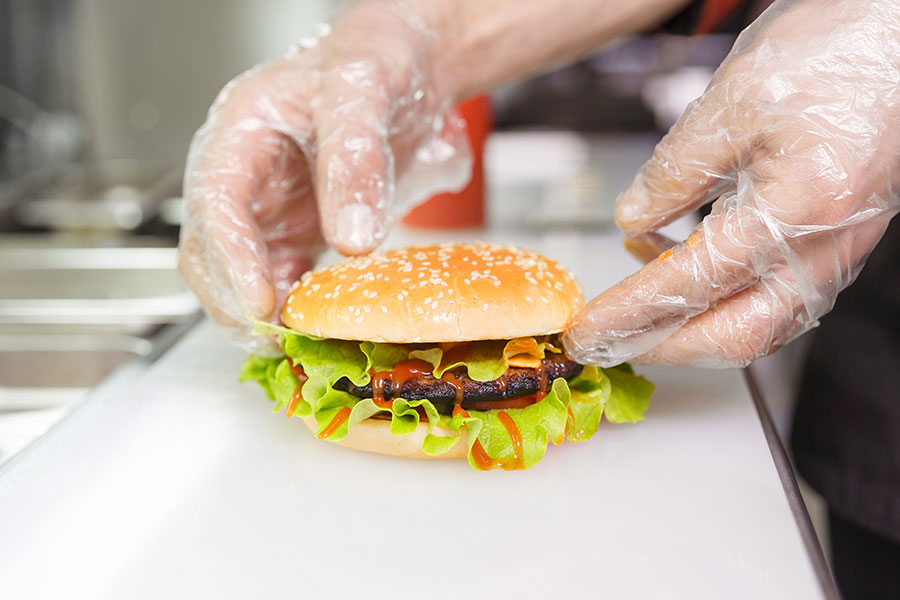
Compare food preparation glove samples through the complete task: taking a glove from its pack, putting it on, performing the intended work and changing it under the food business's procedures. Keep measured fit, seams, dispensing and product documentation visible in the comparison. A sample that feels satisfactory for a few seconds on an empty hand has answered only a small part of the buying question.
This guide concerns loose-fit disposable film gloves for specified food-handling applications. It does not provide a method for approving medical or chemical-protection gloves, and it does not establish food-contact compliance. The purpose is to help a distributor or food-service buyer organise a comparable sample evaluation and identify the next question when something fails.
Before anyone opens the sample boxes
Identify each product and keep the supplied labels. Record the supplier's sample reference, material description, stated size and batch information. If the packaging contains a different product name or count from the accompanying document, resolve the identity before treating the sample as representative of the proposed order.
Ask which finished product the food-contact information concerns and which use conditions it supports. The FDA reference on food types and conditions of use distinguishes food categories and temperature-related use conditions. It is a useful reminder to describe the application precisely; it does not certify a particular glove or replace the product-specific review.
State the intended food tasks and conditions in the buying brief. A product considered for serving prepared items is not automatically established as suitable for every hot, oily or prolonged-contact task. Keep activities outside the supported scope out of a live food-service trial until the responsible business has addressed suitability.
HENSEIN-BIO's disposable film food glove product identifies a relevant format for discussion. Its photograph and product category do not establish the exact dimensions, documentation or performance of a future order. Match those details to the finished sample being reviewed.
Replace the size label with measurements
Measure overall glove length and palm width using a consistent relaxed method. Note the shape and length of the fingers, the wrist opening and how the glove lies flat. If the supplier uses another size convention, obtain its meaning before comparing two products both labelled large.
EcoSafe's food preparation glove listing states palm-width information alongside size names. Those are its own product dimensions, not HENSEIN-BIO specifications. The useful purchasing practice is to connect a size label to physical measurements and then assess the fit on the intended users.
Where film thickness is part of the comparison, identify the measurement basis. A flattened glove presents more than one layer in many positions, and seams create a different measurement location from an open body panel. Ask for the method and location behind a thickness figure rather than comparing unexplained gauge numbers.
Do not interpret a thicker sample as automatically more suitable. Opening, fit, movement and seams contribute to the finished task. If several construction features differ, keep them in the record and compare the complete designs without assigning the result to thickness alone.
Follow one glove from the box to the task
Set up the evaluation at a representative workstation. Keep the box or dispensing pack in the position staff will use and note whether the pack is new, partly used or near empty. A glove that comes away cleanly from the top of a demonstration stack may dispense differently through the actual pack arrangement.
Observe how staff locate the opening and separate a single glove. Record any need to pull apart several gloves, reposition the pack or discard a glove damaged during removal. Keep a dispensing difficulty distinct from a tear that occurs later during work.
For putting on the glove, use the hand condition allowed by the business's procedures. Ask users to follow the normal sequence rather than stretching or altering a sample to make it fit. Include relevant hand sizes and retain observations separately where fit differs between participants.
Check finger reach, excess material and movement around the thumb and palm. A loose-fit film glove will not behave like an elastic examination glove. Assess whether it allows the specified food-preparation action instead of treating a closer fit as an automatic improvement.
Begin with controlled handling tasks where that helps establish fit without introducing food-contact uncertainty. Then conduct any application trial within the site's approved food-safety and hygiene procedures, using products whose intended use has been reviewed. Gloves do not remove the need for those procedures.

Choose observations around the actual work
For a portioning task, observe whether the glove interferes with the intended grip and movement. For assembly or serving, observe access to the items and the way the glove behaves during repeated hand movements. Identify the utensil or object involved so the task can be repeated for another sample.
Keep the duration and sequence defined. If the application involves frequent changing, include removal and replacement in the comparison rather than examining only the glove during use. If a sample catches on a particular workstation feature, record the contact point and check whether it represents normal working conditions.
Avoid introducing unsupported uses just to broaden the evaluation. A glove intended for a specified food task should not be assessed as a chemical cleaning glove or heat-protection glove without an appropriate separate specification. Keep the trial connected to the purchasing brief.
Where one design needs a different handling method, decide whether that change is acceptable for the operation. A sample should not receive an uncomplicated approval if it works only after staff adopt an unplanned workaround. Record the method that produced the result and who would need to implement it.
Describe a failure by location and stage
Retain a failed sample where practical and identify its reference before further handling obscures the problem. Note whether the issue occurred during dispensing, putting on, the work sequence or removal. A torn glove found after the task may require investigation before its cause can be assigned confidently.
Use locations that another person can recognise: fingertip, finger base, thumb junction, palm panel, wrist opening or a particular seam. Distinguish separation along a joined edge from a tear through adjacent film. A report that says only “weak glove” gives the supplier little basis for a targeted response.
| Observation | Detail to preserve | Follow-up question |
|---|---|---|
| Difficult opening | Pack position, separation action and sample condition | Is the issue in dispensing, the opening or handling? |
| Tight finger or thumb area | User fit information and the movement concerned | Does the proposed size or shape need another trial? |
| Tear during putting on | Origin and the action immediately before it | Was the sample forced, caught or damaged beforehand? |
| Separation at a seam | Location and retained sample | Which joined area needs examination? |
| Slipping or interference during work | Task, object and hand movement | Is the complete design suitable for this activity? |
| Several gloves leave the pack together | Pack stage and frequency observed | Does the dispensing format need investigation? |
Treat a small sample trial as a screen for questions and differences. It cannot establish a shipment-wide defect rate or show that every batch will behave the same way. If a repeated pattern matters to the purchasing decision, agree further sampling or testing and keep the scope of that work explicit.
When a supplier offers a revised sample, identify what changed. A new palm width, film construction or seam arrangement can each affect the task. If several features change, evaluate the revised finished product as a whole and retain both specifications so the comparison remains understandable.
Reconcile the documents and the quantity being bought
Keep food-contact documents, compostability information and sample-handling observations in separate parts of the same product file. They answer different questions. A favourable task trial cannot establish a regulatory or certification claim, and a document for a material does not automatically describe every finished glove construction.
Match product identifiers and the applicable scope. If the glove, print or packaging changes, ask whether the supporting information still applies to the supplied version. Check any proposed certification-mark use with the relevant scheme and authorised party rather than treating a logo on an old sample as sufficient evidence.
Clarify whether a quoted quantity means individual gloves or pairs. Record individual gloves per box or inner pack, packs per carton and the total individual count. If a product is genuinely supplied as pairs, identify that convention rather than converting silently between units.
For an illustrative packing calculation, 100 individual gloves per inner pack and ten inner packs per carton gives 1,000 individual gloves. It does not mean 1,000 pairs. Those are hypothetical counts used to explain the calculation, not a HENSEIN-BIO packing offer.
Count comparison samples using a defined approach and keep observations attached to the pack reference. A single checked box can reveal a discrepancy worth investigating, but it does not establish the count of every carton in an order. Agree the receiving check that matters to your purchasing operation.
Keep quotation arithmetic separate from performance estimates
Compare quotations on the same count, dimensions, packing and delivered-cost basis. If one price excludes a retail dispenser or uses a different inner-pack count, record the difference before calculating a cost per thousand individual gloves.
Operational losses can also affect a pilot comparison, but use observed figures carefully. If gloves are discarded during a limited trial because of dispensing or fit problems, describe the observed number and conditions. Do not extrapolate a small trial into a guaranteed ongoing saving or a predicted failure rate for a supplier's complete production.
Separate the reason for discard where the operation can identify it. A glove damaged while being pulled from a box, an unsuitable size and a glove changed under normal hygiene procedures have different meanings. Combining them into one supplier defect number would misrepresent the comparison.
Finish with an approval that has a defined scope
The approval record should identify the measured glove, its packaging, the intended work and the conditions reviewed. Attach the relevant documents, participant observations and the retained reference sample. State any further question that must be resolved before the business expands use beyond the evaluated task.
Keep the pack format in that approval. Changing from a loose inner pack to a dispenser box can affect the point at which staff take a glove. Changing the carton arrangement can affect identification and receiving. Those changes may require a targeted review even when the glove outline remains the same.
Use batch references and the supplied storage conditions to manage retained samples and incoming stock. A comparison between an old unprotected sample and a newly delivered pack may reflect different histories as well as different designs. Record that limitation before attributing a change to the supplier's current construction.
For a repeat order, confirm the specification and the intended application still match the approved case. If users, task conditions or the finished product change, decide what needs to be checked again. The approval should remain a usable description of the gloves and work concerned, rather than a permanent endorsement attached to a product nickname.
The food preparation glove range provides a starting point for identifying formats. Send HENSEIN-BIO your glove sample comparison brief, including measured fit requirements, intended tasks, relevant use conditions, dispensing format, count basis and the documents you need reviewed for the proposed finished product.