

Before sending a shopping bag logo to print, place it on the finished bag drawing. Show the handles, side folds, bottom seal and intended filling level. A logo that looks centred on a rectangular screen proof may sit across a fold, disappear behind the contents or move into the handle area when the bag is carried.
For a retail packaging buyer, artwork approval should connect the graphic file to a specific bag construction and printing arrangement. It should also identify which version belongs on the retail pack and outer carton. That connection is what lets a repeat order reproduce an approved product instead of reopening decisions from an old email attachment.
Ask for the bag outline before finalising the design
Use the current dimension drawing for the construction being quoted. It should distinguish the flat body, side gussets, handle shape and total height. Ask the printer or supplier to mark the proposed print area and any production restrictions on that drawing. Do not invent a universal distance from the bag edge and assume it applies to every machine and bag format.
On a T-shirt bag, show where the upper body narrows into the handles. Identify the portion below that transition that remains visible when the bag is filled. Where a side gusset opens during use, indicate which panel will carry the artwork and whether an element crosses the fold.
A die-cut handle bag has a different upper outline and hand opening. If the project changes from one construction to the other, obtain the corresponding artwork outline. Scaling a T-shirt bag proof into a die-cut template can preserve the logo size while placing it in an unsuitable part of the finished bag.
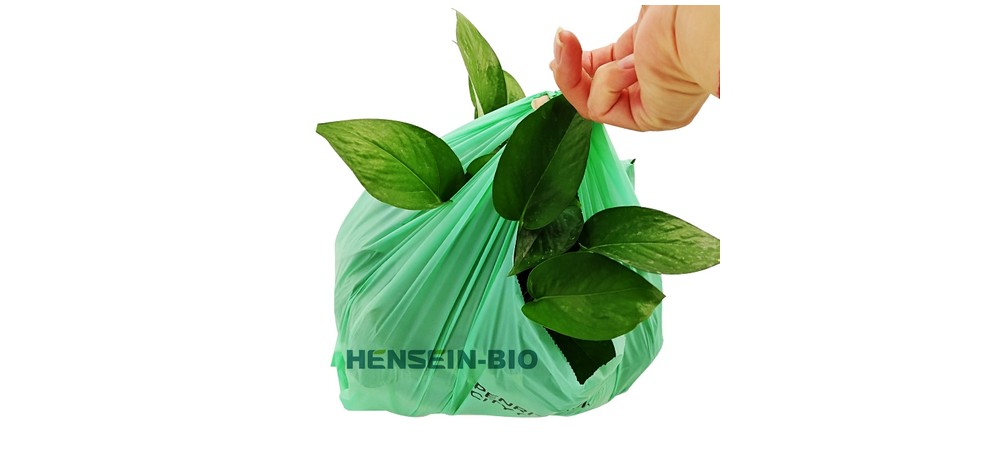
The printed singlet carry bag product shows a relevant format in the HENSEIN-BIO range. Use it to identify the construction you want discussed, then confirm the print-area drawing for the actual proposed order.
Decide what customers need to read while carrying it
Give the main brand element enough clear space to remain recognisable when the bag is filled. Put information that requires careful reading in an area that can be inspected without unfolding a gusset. The purpose of the bag influences the design: a checkout carrier, a retail gift bag and a pack sold as a household product have different communication needs.
Inspect the bag at more than one filling level. A low load can leave a large unprinted-looking space above the contents, while a bulky load can stretch the visible arrangement around corners. Where the logo sits against an irregular object, check whether the message still reads naturally.
Separate a decorative illustration from instructions that affect use or disposal. Important text should not depend on a customer recognising a faint symbol in a crease. If the intended market requires particular wording, have the responsible brand or compliance owner approve that wording before it enters the production file.
A filled sample can answer a placement question that a flat PDF cannot. It cannot prove the technical accuracy of a product claim. Keep the design approval and the approval of the words as distinct decisions, even when the same person signs both.
Specify colour on the actual film background
State the proposed film colour and appearance with the artwork. A printed colour on natural, coloured or translucent film will be viewed with a different background from the white page on which a logo was designed. The contents of a translucent bag may also affect the appearance seen by a customer.
Choose the physical colour reference with the supplier or printer and identify the film background and proposed printing process beside it. Review the actual printed appearance on the intended construction. Use a screen proof for layout discussions and an appropriate printed reference to approve how the ink and film combination looks.
Ask which physical reference will control the colour discussion. Keep its identity and condition with the proof. If the design needs a white underprint or another treatment to achieve its intended appearance, identify that requirement explicitly and have the proposed printing arrangement reviewed. Do not assume white areas in a digital file automatically mean opaque white ink.
Large solid areas, fine type and reversed-out details deserve separate inspection. Check whether small characters remain readable, whether counters in letters remain open and whether the intended contrast survives on the actual background. Agree the evaluation with the supplier instead of imposing a minimum type size taken from an unrelated packaging project.
Use a proof sequence that closes a different question each time
Check the exported production file as well as the designer's working file. Confirm that the intended fonts, linked images and language characters are present in the version sent for review. Where the printer requests vector artwork, outlined text or a particular file format, agree that requirement before export. Keep an editable master under the brand owner's control so a later wording correction does not depend on reconstructing flattened artwork.
Compare the export against the approved text line by line, including quantities and small disposal instructions. A technically readable file can still contain an earlier translation or an outdated product code. File compatibility and content approval are separate checks.
The first layout review should settle placement and content. Confirm the bag outline, dimensions, artwork orientation, printed sides and which file version the team is reviewing. Make corrections on the same controlled proof rather than circulating several files that all claim to be current.
A printing review then checks whether the proposed graphic can be produced as intended. The supplier or printer should identify practical constraints and any necessary adjustment. If the design changes during that review, return the changed areas to the brand owner. A technical adjustment can also alter a visible brand detail or a line of instructions.
Where a physical printed sample is part of the agreed project, inspect it on the proposed film and construction. View it flat, filled and carried. Check placement, readability and the appearance of the printed surface under the handling appropriate to the bag. Record the conditions behind any claim about print resistance; do not turn a brief hand inspection into an unsupported durability guarantee.
The approved physical sample and approved graphic file should refer to each other. A signed bag with no file reference leaves the next order open to interpretation. A versioned file with no physical comparison leaves the team without a reliable reference for appearance on film.
Keep certification marks out of the design until their use is established
A compostability mark is not an ordinary decorative icon. Identify the applicable scheme, the finished product concerned and the party entitled to use the mark. Check the current requirements with the scheme owner before approving a logo copied from an old catalogue or another company's bag.
For example, BPI's guidance on using its certification mark provides the relevant route for its own mark. Its FAQ on certification and sublicensing also distinguishes finished products and brand arrangements. Those sources do not establish that a particular HENSEIN-BIO product or proposed private label artwork is authorised.
Keep the approved mark file separate from a designer's redraw. Include any required identifier, wording, size or presentation rule in the proof review. If a proposed ink, film thickness, construction or brand arrangement changes, have the responsible party check whether the supporting product scope and label use still apply.
Disposal wording needs its own scope as well. A bag's material claim does not establish acceptance in every collection program. Use instructions appropriate to the intended market and the product's supported claim. Broad promises about disappearing in nature do not become reliable because they are printed beside an authentic-looking symbol.
Create one handoff record for the bag, pack and carton
Artwork approval often involves several items that reach different people. The end customer sees the bag or retail pack. A warehouse team may see only the carton. The file set should make it possible to match those items to the same product without interpreting informal filenames.
| Item | Information to identify | Review question |
|---|---|---|
| Bag drawing | Construction, dimension revision, handles, gussets and seal | Does this outline describe the bag being ordered? |
| Bag artwork | File version, print sides, orientation, colours and print area | Is the visible design the approved version? |
| Claim or mark file | Approved wording, relevant product reference and permission record | Does this use match the supported scope? |
| Retail pack | Product identity, count, language and artwork revision | Does the pack describe the bags it contains? |
| Outer carton | Product code, quantity basis and destination information required for the order | Can receiving staff distinguish this version from another? |
| Physical sample | Sample reference and the files it represents | Can appearance and construction be checked on repeat supply? |
If the carton states a total bag count, calculate it from the agreed pack arrangement. Keep bags per bundle or roll, inner packs and cartons distinct. A design file can reproduce a quantity error perfectly, so the count should be checked as product data rather than treated as part of the illustration.
Assign responsibility for approving text, graphics and product data. This can be a simple list of names or roles in the purchasing file. The point is to know who resolves a question when a translation changes a line length or a packing change alters the count on a carton.
Reopen approval when a change affects the finished result
A colour correction may require only a targeted review when the bag and all other fields remain unchanged. A new bag size, gusset or handle outline can change the placement of the whole design. Describe the change before deciding how much of the earlier approval still applies.
Changing the film background deserves another appearance review. The ink reference may be unchanged while the customer sees a different contrast. Changing the brand or adding a certification mark requires the relevant content and permission checks. Changing the bag count requires a review of the retail and carton text even if the bag print is identical.
Keep obsolete files clearly separated from the current production set. A useful filename includes a product identifier and revision, but the purchasing record should also state which revision is authorised. An email attachment called “final” becomes ambiguous as soon as the next correction is made.
Before a repeat order, compare the inquiry against the retained specification. Ask whether the same construction, artwork and pack arrangement are intended. If the team wants a different version, issue it as a change with the affected files identified, rather than relying on an informal note to an old purchase order.
Send the artwork with the questions it must answer
Use the shopping and T-shirt bag range to identify the format for your inquiry. Send the bag drawing, proposed film background, logo files and the text that must appear. Indicate the intended printed sides and the parts of the design that are colour-critical or need close reading.
Include the retail pack and carton requirements if those are part of the project. Where a claim or certification mark is proposed, provide the relevant product and authorisation references for review. Leave unsupported claims out of the artwork rather than letting a polished proof create the impression that approval has already happened.
Discuss your shopping bag artwork and product brief with HENSEIN-BIO. A drawing tied to a controlled file set gives the next discussion a clear starting point for print placement, sampling and order-specific requirements.