
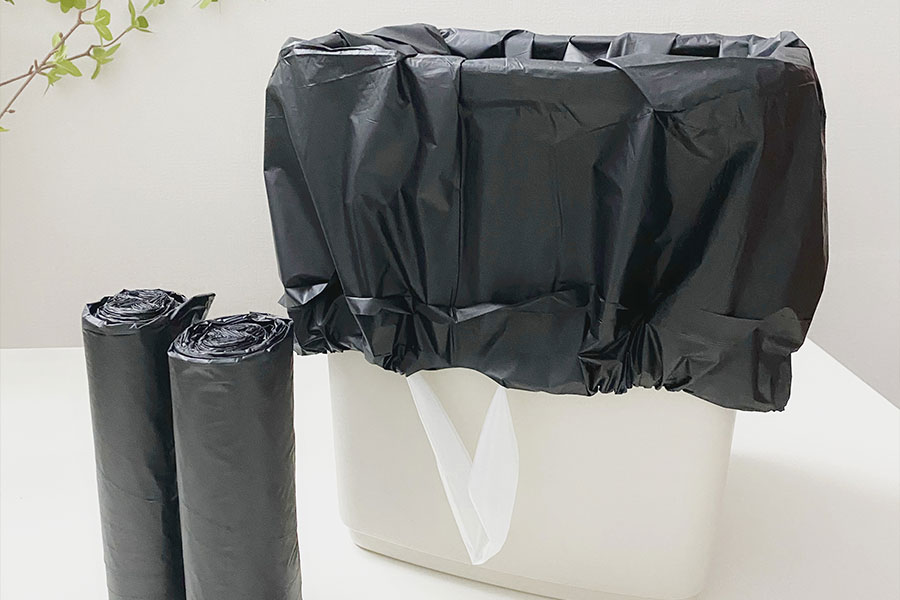
Choose a drawstring bag when staff can lift the cuff off the rim, gather the opening and close it comfortably with the bin loaded to its normal change point. A straight-top liner suits a routine where staff already fold or knot the open film and the bag leaves enough clean material above the waste to do it. Try both in the actual bin. An easy pull on an empty bag tells you very little about how the liner will come out from under a retaining ring at the end of a shift.
The useful comparison starts with one bin and one collection routine. A shallow kitchen bin emptied several times a day puts different demands on its closure than a tall shared bin emptied by a cleaning crew. Write down who fits the liner, when they change it and where they put it immediately after removal. The distance between bin and cart can change which part of the bag people grip, even when they follow the same closing steps.
Follow the film at the mouth
A drawstring runs through or along a channel near the bag opening. When the exposed parts of the string are pulled, the film gathers around the opening. Check how far the opening closes with the intended load in place and whether the gathered neck stays closed through the next handling step. A ring of gathered folds can remain around an opening even when both ends of the string have been pulled. If liquid containment is important, assess it separately under a suitable protocol.
On a straight-top liner, the operator brings the film together by hand. With a simple knot, part of the open end becomes the neck and part goes into the knot itself. A site that folds the top into a cart may need very little handling room. A site that ties every liner and carries it through a corridor needs enough clean film to make that knot after the cuff comes off the bin. A wider mouth can give more film to gather, although an especially wide opening can also be awkward to hold together in one hand. Put the actual operators on the trial and observe where their hands go.
See the opening on the kitchen drawstring bag product page. Ask for a drawing that marks the channel, string exits and usable body. Try the quoted version in your bin at the usual change level, with the operator wearing the gloves they use on shift.

Fit the cuff around the hardware
Start by fitting each candidate the way the bin is normally set up. Fit the cuff under the lid or retaining ring if there is one. Close the lid, work the pedal if applicable and check that the bag stays positioned as contents go in. A thicker drawstring channel may sit differently under a narrow retainer than plain film. On a bin with a sharp corner, a lid hinge or a bag cinch, photograph where the channel lands and whether either string exit catches.
A bag can cover the mouth of the bin and still leave too little material to close. The cuff borrows some length from the body while it wraps around the rim. When the bag comes out, that film is available again, provided it has stayed accessible and reasonably clean. If the fill reaches the rim, the folds can be pressed against the contents. If the bag rides up during filling, film intended for the closure may end up inside the bin. Mark the intended change point on a trial bin so operators can reproduce the same setup.
Identify where the closure and the usable body start on both drawings. For a drawstring liner, mark the lower edge of the channel and ask how the stated length is measured. For a straight-top liner, mark the minimum free film the operator needs above the contents after unhooking it. Record the bin model and rim hardware beside both measurements. A retailer buying for several customer sites can use the same fit record, but it needs a separate line for each rim arrangement.
Some containers provide their own method of securing a liner. Rubbermaid Commercial, for example, describes rim cinches on its Vented Slim Jim container. A bin designed with that hardware may let staff secure plain film without tying it around the rim. When evaluating a drawstring version on such a bin, check that the cinch releases cleanly and leaves the channel usable. The instruction for that bin model is a better guide to installation than a generic bag label.
See what takes the weight when staff lift
With the bag still supported inside the bin, watch how the operator pulls the string or gathers the film. The next move can put a different force on the mouth. Someone who grips both sides of the gathered neck may load the film differently from someone who lifts with the two loose ends. If people normally slide the bag directly into a cart, reproduce that action. If they hold it suspended while opening a door, include the handling that actually occurs on that route.
On the drawstring sample, look at the channel seam, the string exits and the transition from the neck to the body. Note whether the string slips through, the channel starts to separate or the bag stretches away from the gathered top. On the straight-top sample, look at the knot and the nearby folds. A split through the gathered film calls for a different discussion from a leak at the bottom seal. When the film has torn, photograph the first visible damage while the bag is supported so the evidence stays close to the original failure.
For liner bodies with similar dimensions, close one of each with the same representative contents. Start with clean stand-ins and use a safe lift agreed with the site. When the two products differ in film construction or seams, report the outcome as a comparison of those finished samples. To identify the contribution of the closure by itself, you would need a more controlled pair and a method that holds other important factors constant.
| During the change | Drawstring sample | Straight-top sample | What to record |
|---|---|---|---|
| Fit the bin | Locate the channel and string exits against the rim hardware | Fit the film around the same rim or retainer | Where the cuff sits, whether the lid closes, any point that catches |
| Release the cuff | Free the channel and reach the exposed string | Pull up enough clean film to gather by hand | Whether the top slips inward or catches on the load |
| Close the bag | Pull through the normal range and observe the remaining gap | Make the knot or fold the site actually uses | Remaining opening, slack and whether the closure holds its position |
| Transfer to the cart | Grip the specified support points for the trial | Grip the gathered film or support the bag as the site does | First point that slips, tears or becomes difficult to hold |
| Set down | Inspect the neck after the load settles | Inspect the knot and the film around it | Any reopening, visible damage or change to the closure |
Compare the awkward changes as well as the easy ones
Pick a routine change first. Use the normal fill level, the usual operator gloves and the cart placed where it would be on shift. Put a fresh sample into the same bin for the second design. A staff member who changes these bins every day will often spot a blocked string exit or an awkward grip faster than someone standing at a bench. Ask them to show the movement that caused trouble before you ask which design they prefer.
Then repeat the trial with the condition that has caused problems on site. If the bag tends to slump inside the bin before the end of a shift, start by checking retention. When the issue is a bulky load that reaches into the neck, make a second fill with an item projecting into that space. For a long transfer, include the cart approach and any door threshold. Write the condition beside the result. A design that closes promptly in a dry staff-room bin may need a different free neck length in a kitchen where the liner is changed with gloves on.
If the crew has to tug at a stuck liner, stop and look at the cause before repeating the pull. The bin may grip the filled liner against a narrow section or the cuff may still be caught on hardware. Moving the fill line or changing the release routine may solve the observed problem. If a different bag is needed, the record should say which dimension or feature has to change. An instruction to supply a stronger bag leaves several possible causes unresolved.
Observe a replacement liner installation after each removal. Some differences show up in the next cycle, when an operator must open a new bag with gloved hands and fold its top neatly under the rim before the bin can return to service. A closure that saves time during removal may still be a poor match for a narrow retainer if it takes repeated adjustments to install.
Write the purchasing decision around the route
For each bin, keep a short record that someone else can use. Identify the bag sample and lot, the bin model, how the rim holds the bag, the usual change point and the type of contents. Add the operator's close-and-transfer sequence and the observed failure, if any. Use a plain description such as “right string exit caught under rear hinge while pulling the cuff free.” That gives the supplier something to reproduce and tells the site whether the problem may be tied to one bin.
Give the closure checks their own acceptance criteria. If staff must be able to find both ends with gloves on, put that in the record and agree how it will be observed. If a straight-top liner should keep enough clean neck for a specified knot, include a photo of the reference knot and the fill condition. A bag that needs a different knot, lower fill level or two people for a one-person transfer changes the operation. Decide whether that change is practical before accepting a sample on price or appearance.
If both versions pass, compare costs using the usable quantity and the routine your team will actually follow. Confirm the number of liners per roll and carton for each quotation. Extra film left for a knot and a separate drawstring channel are different ways of achieving closure. Price comparisons make sense once both designs meet the same change routine, with any different packing or installation needs visible in the quote.
Where a compostability claim is part of the order, ask which exact finished construction the evidence covers. For the drawstring version, identify the string and channel in the submitted specification and check whether any printed version is included. Keep that document review beside the closure trial. BPI describes how its schemes evaluate finished products and components. The relevant scheme and the collection operator's instructions depend on the market and disposal route.
Use the drawstring bag category to identify a format for the trial. When you send your liner requirements to HENSEIN-BIO, include a rim photo, the bin model, how the bag is normally closed and where people grip it during transfer. If a closure has caught on the rim or slipped while being carried, include a photo of that point and the fill level at the time.