

Choose a dog poop bag by its usable space during collection and tying. Start with a finished bag, measure it flat, and then try it over the hands of the people who will use it. The bag must open easily, cover the hand during collection and leave enough clean material to close. A larger nominal size can still fail one of those jobs if its handles, seal or perforation occupy the space the buyer expected to use.
For pet brands and wholesale buyers, the useful output is a dimension drawing supported by a repeatable fit trial. That gives a supplier something clearer to quote than “standard size” or “suitable for large dogs.” It also helps identify where a smaller bag would remove unnecessary film and where reducing a dimension would make the product awkward to use.
Put the measurement convention on the drawing
Lay an unused bag on a smooth surface without stretching it. Identify the open end, the bottom seal and any gussets or handles. Measure the finished outside width and total length first, then record the space available inside the sealed body. Keep millimetres as the working unit if that is how your production drawing is prepared; convert a retail label separately and keep the rounding visible in the approval record.
The terms below prevent several common specification disagreements.
| Field | What to identify | Why the distinction affects fit |
|---|---|---|
| Flat width | Outside width of the relaxed, flattened bag | It provides a starting comparison, but does not describe an expanded gusset |
| Total length | Finished end-to-end length, with the measuring endpoints marked | A handle section or separation edge may be included |
| Usable body length | Internal space from the opening or handle transition to the bottom seal | It is the space available for collection before closure allowance |
| Bottom seal position | The joined area and any film extending beyond it | Material below the sealed interior cannot increase capacity |
| Handle length | The portion above the usable body on a handle bag | It changes how the bag closes and how overall height is interpreted |
| Gusset dimensions | Each fold, with the drawing showing folded and expanded measurements | A quoted width may otherwise describe a different construction |
A flat-top roll bag and a tie-handle bag therefore need different drawings. On a roll bag, identify where one bag ends at the perforation. On a handle bag, show the transition between the body and the handles. Do not use the same outline and simply change the product name.
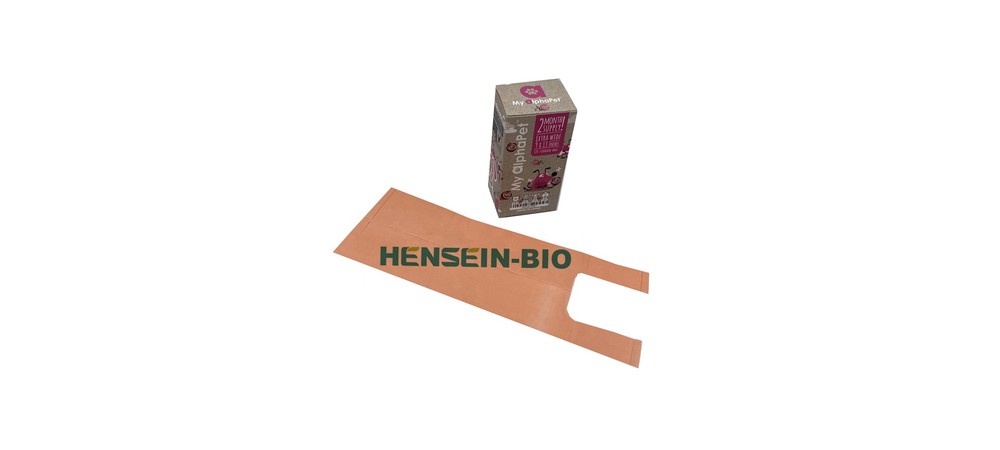
HENSEIN-BIO's tie-handle dog waste bag product is an example of a construction where total height and usable body height should be considered separately. Its photograph shows the format; it is not a dimension drawing for your order.
Check hand coverage before adding waste
Ask several intended users to put a hand into the sample in the way they would normally collect waste. Include the larger hands likely to use the retail product. If gloves are a normal part of that use, include them in the trial. A bag that fits a bare hand closely may behave differently over a glove or when the user needs to spread their fingers.
Look at the opening as well as the bag body. Can the user find and separate the mouth? Can the hand enter without forcing the opening or pulling the film tight around the knuckles? Does the bag reach far enough beyond the wrist for the intended collection motion? These observations describe a fit problem more clearly than a general comment that a bag “feels small.”
Repeat the exercise without telling users to compensate for the design. If the sample only works after someone teaches an unusual grip, record that. A retail customer will usually have the bag and its printed instructions, not a procurement specialist demonstrating a workaround.
Keep hand coverage separate from film strength. If a user must stretch the opening to enter, increasing thickness will not create more relaxed opening space. Conversely, a roomy bag can still have a film or seal problem. Record which part of the task failed before requesting a change.
Use a consistent simulated collection load
Dog size is a rough description of a customer group. It does not define the shape or volume of every collection. For a comparison trial, use a clean, repeatable surrogate that represents the intended collection size and handling difficulty. Define its dimensions, approximate mass and surface characteristics so another person can repeat the exercise.
The surrogate should help assess reach, gathering and closing. It should not introduce sharp edges that the real task does not involve, or make a difficult collection seem easy by using an unusually compact object. Keep different intended use cases separate. A bag for one collection and a bag expected to gather more than one deposit are different sizing briefs.
Have each participant cover the hand, gather the surrogate and turn the bag over the contents. Watch where the opening travels. Does it slide back towards the fingers? Does the user lose their grip while inverting the bag? Is the bag body deep enough for the contents to sit below the area needed for closure?
Measure and describe the trial load rather than presenting a photograph as proof of capacity. Record the observations as results for those samples and conditions. The exercise does not establish a universal weight rating or guarantee that every customer will handle the bag in the same way.
Reserve clean material for the closing method
A flat-top bag needs enough free neck to gather and tie after the contents are enclosed. A handle bag needs enough usable body space below the handle transition, together with handles that can be brought together and tied comfortably. In either case, check the closure after collection; a knot made in an empty bag says little about the space left after use.
There is no single closure allowance that can be applied to every bag, hand and load. Establish it through your trial. Mark the portion consumed by gathering and tying, then compare what remains below the closure. If users consistently struggle to form the knot, determine whether they need more body length, a different opening width or a different handle geometry.
Avoid adding a large length allowance to fix every complaint. Extra film at the bottom does not necessarily improve the grip at the opening. More width may help a broad hand but produce a bulky neck when gathered. A useful sample request changes one feature at a time so the reason for an improvement is visible.
For repeat orders, photograph the approved filled-and-closed sample beside its reference label. Keep the flat measurement drawing as the dimensional authority. The filled photograph documents the task and the closing method; it should not be used to infer measurements from perspective.
Calculate the film-area effect of a proposed reduction
For a simple, ungusseted bag made from two rectangular panels, the approximate film area before considering manufacturing allowances is twice the flat width multiplied by length. This provides a quick comparison between two proposed sizes. Handle cutouts, gussets and other construction details require their own treatment.
Consider an illustrative comparison between a 230 × 330 mm flat-top bag and a 220 × 320 mm version. These are example dimensions, not HENSEIN-BIO stock specifications.
- First size: 2 × 0.230 × 0.330 = 0.1518 square metres.
- Second size: 2 × 0.220 × 0.320 = 0.1408 square metres.
- Difference: 0.0110 square metres per bag, or approximately 7.2% of the first size's calculated area.
That percentage describes geometry at an unchanged construction. It is not a quotation saving, a measured reduction in environmental impact or evidence that the second bag will perform as well. Film thickness, material density, production waste, printing and packing can change the relationship between area, weight and delivered cost.
Use the calculation after a successful fit trial. If the smaller bag forces users to stretch the opening or leaves insufficient tying space, the area reduction has removed part of the required function. If both sizes work under the same conditions, the calculation gives the buyer a useful question to investigate in the quotation.
Record thickness independently. ASTM D6988 concerns determining the thickness of plastic film test specimens; a thickness measurement does not establish usable bag capacity. Keep dimensional fit, film measurement and finished-bag handling as separate entries in the approval record.
Run a comparison that can explain its result
Label samples A and B with their measured dimensions and construction. If the purpose is to compare width, hold the nominal length, material construction and closure style constant as far as practicable. If several features change together, describe the result as a comparison of two complete designs. Do not attribute the difference to width alone.
Use the same participants, surrogate and collection sequence for each design. Alternate the order in which participants try the bags so the second sample does not always benefit from practice. Give each participant fresh bags and record repeated attempts instead of keeping only the best attempt.
An observation sheet can be concise. It needs enough detail to support a decision when the team reviews it later.
| Trial entry | What to record |
|---|---|
| Sample identity | Supplier sample reference, construction and batch information supplied |
| Measured dimensions | Flat width, total length, usable body length and relevant handle or gusset dimensions |
| Intended user | Relevant hand-size range and whether a glove was used |
| Trial load | Surrogate description, dimensions and approximate mass |
| Collection result | Entry, coverage, gathering and inversion observations |
| Closing result | Method used, remaining neck or handle space, and difficulty tying |
| Failure location | Opening, film body, bottom seal, perforation or handle transition |
| Decision | Accept for this use, change a named dimension, or investigate another feature |
Descriptions such as “opening pulled tight at the knuckles” and “insufficient neck after inversion” are actionable. A score of three out of five without a definition is harder to use. If the team wants a rating scale, define each rating before comparing samples and retain the written reason beside it.
Agree the tolerance around the approved fit
An approved nominal dimension is only part of a purchasing specification. Ask how finished dimensions will be checked and agree the permitted variation with the supplier. Do not assume a tolerance simply because another bag order used it.
The smallest acceptable usable dimension deserves attention. A nominal sample may work comfortably while a shorter or narrower bag near the agreed lower limit does not. Where fit is close, ask for samples that represent that boundary or arrange another way to evaluate it before approval. Leave room for ordinary handling variation rather than selecting a design that works only under careful demonstration.
Specify measurement locations and the condition of the bag during measurement. A relaxed bag measured immediately after unfolding can give a different practical reading from film pulled taut against a ruler. Keep the technique consistent, and identify whether handles, folds or the seal determine an endpoint.
Retain the drawing revision, approved sample and fit-trial record together. A later change to handles, bag count per roll, printing layout or packing should prompt the team to ask whether the approved size or the way it is used has changed. A familiar product name is not enough to establish that the construction is unchanged.
Send a sizing brief that leads to a useful sample discussion
The dog waste bag range provides a starting point for comparing roll and tie-handle formats. Select the construction first, then send a marked drawing showing outside and usable dimensions, the intended closing method and the fit problem the sample must solve.
Include the expected users and collection scenario, the dispenser measurements if the bag is supplied on a roll, and the pack format you want reviewed. Keep material and disposal requirements in the brief as separate questions so a fit approval is not mistaken for approval of an environmental claim.
Contact HENSEIN-BIO with your sizing drawing and sample requirements. A marked drawing, a description of the collection task and the observations from your current bag give the team concrete requirements to discuss, without relying on a dog breed label or an undefined standard size.